You only have a week left before your OET? How can you maximize your study time?
Here are a few tips you can use to quickly improve your performance on the OET:
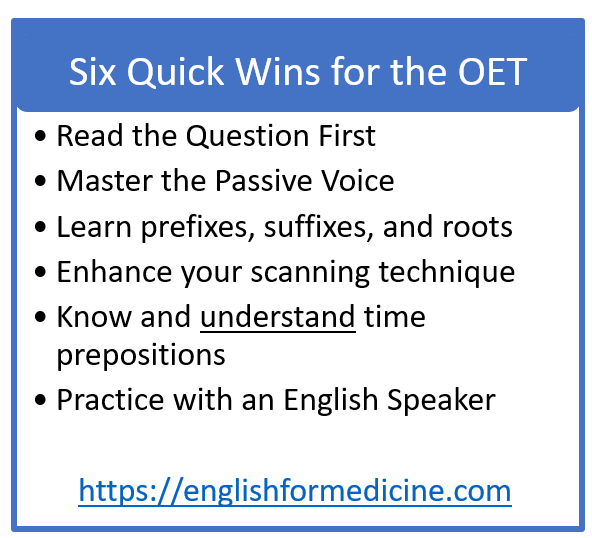
- Read the question first. You have time to do this. This applies to ALL sections. Always read the question first. This will allow you to engage with the material more effectively and efficiently. You can choose to read either just the question or the question and the answer. Either way will activate your brain and get you to interact with the material in a meaningful way.
- Master the passive voice. This is normally frowned upon in most writing. However, in medical communication it is the norm, as it allows for a much more formal, professional voice. Using the verb “to be” and the past participle of the main verb, it shifts the focus from who is doing the action to what is being acted upon. For example: “I ordered blood tests” becomes “Blood tests were ordered”.
- Learn common medical prefixes, suffixes, and root. About 60% of English words and almost 90% of medical terms come from Latin roots. This can rapidly expand your vocabulary. For example: fibrodysplasia, a disease of abnormal collagen formation, can be understood by fibro (fibrous/connective tissue), dys (abnormal), plas (formation), and ia (condition). Learning a few common roots will take less time than routine vocabulary expansion.
- Enhance your scanning technique. Instead of moving your eyes left to right over the page, try moving your eyes up and down the page instead. This will prevent you from being distracted by starting to read when you are supposed to be scanning. In addition, avoid re-scanning the same section multiple times by covering it with your hand once you’ve scanned it. You will scan not only during part A reading, but also when previewing questions for all sections and quickly verifying answers to parts B and C reading.
- Recognize and understand prepositions of time. Know the difference between “for” “since” “until” “ago”. Most patient interactions are the stories of what has happened to them. Understanding the timeline provides important information that is often the source of OET questions.
- Take a practice speaking session with a real English speaker. Conversation skills are the hardest to practice on your own. A few sessions with an experienced Medical English coach can give you valuable practice and increase your confidence on test day.